
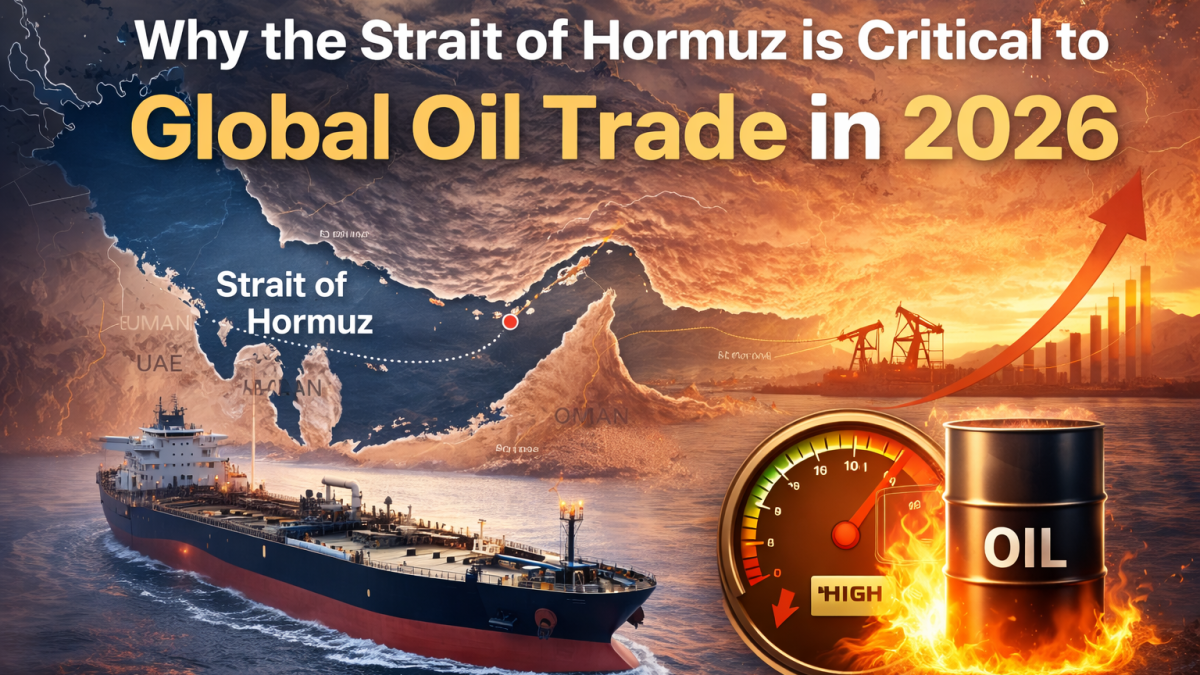
Why the strait of Hormuz is critical to global oil trade in 2026

Discover the importance of the Strait of Hormuz in international trade in 2026, and how this vital chokepoint impacts global oil supply, and global economic stability.
Every day, nearly one – fifth of the world’s oil passes through a narrow sea lane that is only 33 km wide. This waterway – the Strait of Hormuz – has the power to shake global markets within hours of any disturbance.
The Strait of Hormuz is a critical chokepoint for international trade and global supply chains. Imagine if this waterway chokes for an hour, it can significantly worsen the condition of the global energy supply. Wondering why many countries like USA, China, and Russia maintain complex relationships with Iran and how this single waterway creates tension that even leads to global oil trade conflict.
This 33 km narrowest width is the world’s most dangerous maritime chokepoints, and even a single disruption in these waterways can lead to severe shortage of energy shipments.
Geographic and Strategic location
The Strait of Hormuz has been involved in many wars like tanker war during the 1980s and the 1990 Gulf war, there have been frequent news about strait of Hormuz that Iran uses it as strategic tool in response to USA military actions. But before discussing its war history, we need to understand what the Strait of Hormuz is and why is it important for the global trade.
The Strait of Hormuz is a waterway that connect the Persian Gulf to Gulf of Oman, which leads into the Arabian sea for transporting goods from ships, it lies between middle east country Iran and Oman. It is 33 km narrow and 3 km wide in each direction, and several islands including Hormuz Island, Qeshm Island, and Abu Musa are part of strait of hormuz.
The strait of Hormuz is the only sea route for ships to traveling across the Persian Gulf to the open ocean. Many Countries like Kuwait, Oman, Iraq, Saudi Arbia, and Qatar are relying for export import.
This is the most important chokepoint for global fuel and energy trade. About 20 – 25% of the world’s traded oil and a major portion of LNG (liquefied natural gas) passes through it daily.
Role in Global Oil and Energy Trade
The Strait of Hormuz plays a central role in the global energy trade system because it is the primary exit route for oil and gas produced in the Middle east countries like Qatar, Saudi and Kuwait and around 20 – 21 million barrels of oil passes through it daily.
About 20% of global LNG shipments transit through the strait annually and the majority of these exports come from Qatar and it is one of the world’s largest LNG producers, if this strait is blocked for an hour, it would disturb the global energy use and affect badly many Asian countries like India, China, and Japan.
About 85% of india’s fuel imports comes from countries like Saudi Arabia, Iraq, and Kuwait, if the strait is disrupted by war, it will severely impact fuel supply chain and leading to higher transportation costs and other increased energy expenses across industries.
Qatar alone shipped 9.3 billion cubic feet LNG per day through this strait, it has no alternative export route to the open sea, and India has major dependency on it because Qatar is one of the world’s largest LNG exporters. Nearly all exported LNG from Qatar and the UAE must pass through the strait of Hormuz to maintain global energy consumption.
Economic importance beyond oil
Although oil dominates headlines of news, its economic importance goes far beyond petroleum. It functions as critical artery for global trade, regional economies, and financial markets. The strait not only affects fuel transport, but bulk carriers like grains, metal, and chemicals.
The strait connects gulf ports to the wider Indian ocean for importing food, machinery and construction materials, since many gulf countries import their 80% of their food by strait and this strait become vital for their domestic economic stability.
Instability of strait causes higher shipping insurance premiums, rerouting costs and delays in global supply chains, which raises freight rates worldwide that affect retail prices, industrial production costs and inflation in importing countries.
If ships were blocked in strait, countries like Kuwait and Bahrain would face immediate economic contraction, because their fuel supply chain, raw material exports and aviation fuel highly depend on ports.
Risks and global consequences of disruption
Disruption of the Strait of Hormuz is considered one of the most serious geopolitical and economic risks in the world because it is directly connected to trade, global energy, and security systems.
Global oil supply shock
If the strait is blocked or attacked, oil supply exports from Saudi Arabia, Iraq, Kuwait and UAE will be disrupted and global oil markets faces biggest supply shortage of oil within days. Even a partial disruption can trigger panic, as traders quickly price in the risk of future shortages.
Severe impact on Asian economies
Asian countries like China, India, Japan and south Korea being the largest importers of oil, which is passes through only strait of Hormuz and delay in fuel can leads to increase in inflation.
Risk of military conflict
The strait of Hormuz lies between Iran and Oman, making it most sensitive geopolitical zone and this can be easily disrupted by military action, naval blockades or attacks on tankers. The more the route disturbed leads to delay in shipment and import of goods and oil.
Conclusion
The economy of any country is highly interconnected on each other for export import activities, which has large contribution of building a nation powerful. For transporting of goods from middle east country to other country 3 major nation like china, india and japan and their 80% oil depends on strait of Hormuz, ensuring its security and uninterrupted operation become vital for economic stability, energy access and the smooth functioning of global commerce in 2026 and beyond.
FAQ
What is the Strait of Hormuz?
The strait of Hormuz is narrow waterway connecting the Persian Gulf to the Gulf of Oman which leads to open sea, serving as a critical route for exporting global oil and gas transportation to other nation like India, China and Japan.
How does the Strait of Hormuz impact global oil prices?
World’s 1 out of 4 oil barrel passes through these waterways daily, and even a minor disruption like military activity and tanker attacks can reduce supply expectations to meet the demand of oil globally that leads to high jump in oil.
What would happen if the Strait of Hormuz is closed?
The closure of the strait of hormuz can trigger a global chain reaction across energy markets and supply chains, leading to severe oil shortage,
rising transportations costs (everything from food to electronics become more expensive).
Why is the Strait of Hormuz considering a chokepoint?
Strait of Hormuz is only 33 km wide and shipping lane are even tighter for each direction that considered a “chokepoint” because a huge volume of global energy trade is forced through a very narrow, strategic passage that make it highly vulnerable to disruptions.