
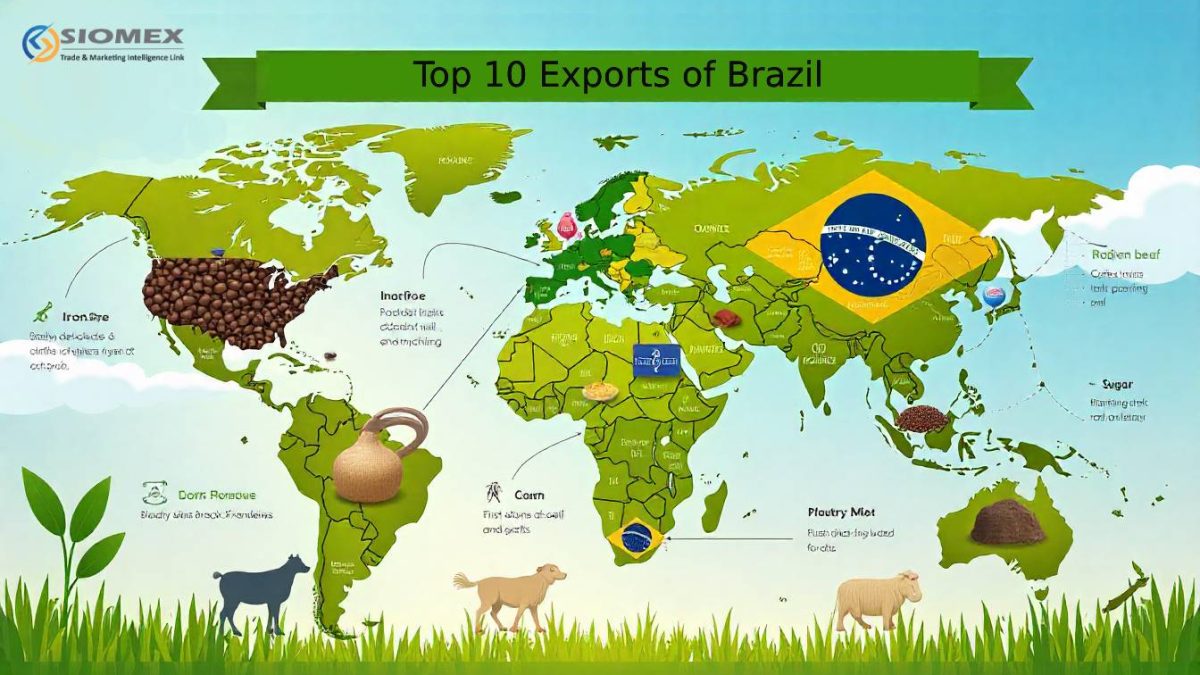
What are the top 10 exports of brazil

Brazil exports is frequently thought of as the country of soccer, samba and the Amazon rainforest. But in addition to its culture and natural splendor, Brazil is also a massive exporter. With its rich soil, Huge forests and robust industries, the country is a world supplier of raw materials as well as products.
If you have ever had a cup of coffee in the morning, nibbled on a piece of chocolate or driven an ethanol-fueled car, there’s a reasonable chance Brazil has played at least some role in your life. But what, in fact, does Brazil send out to the world? Let’s unpack it in bare language.
In this post, we’ll step through the top 10 exports of Brazil to explore what makes them relevant and show how trade data such as that provided by Siomex enables business to keep ahead in the import-export race.
Soybeans – Brazil’s Golden Beans
Soybeans are Brazil’s superstar export. Farmers cultivate them on vast farms, and they ultimately wind up feeding animals from Asia to Europe. Poultry farms in China, for instance, rely heavily on Brazilian soy to keep their chickens healthy and well-fed.
Soybeans are so prized because they can be processed into cooking oil, animal feed and, yes, even biodiesel. To Brazil, they are more than a commodity, they are a ticket to global power.
By-product of an Industrial Whore Iron Ore
And iron ore is basically the backbone of construction and manufacturing. Brazil digs up tons of it and exports the bulk of it to countries like China, where it’s turned into steel. There wouldn’t be any skyscrapers, bridges or even cars without iron ore.
Consider a city skyline — odds are the steel used in those buildings began its life as Brazilian iron ore.
Power of the World
It’s not only farmland and forest, but also oil fields. Its largest exports is crude petroleum, supplying economies all around the world. Brazil is the source of much of the oil that many countries starved for it depend on.
This export adds to Brazil’s leverage because energy is something every country needs — whether for cars, planes or factories.
Flavor of Brazil
When people think of Brazil, they sometimes think of coffee. For more than a century, Brazil has been the world’s biggest coffee exporter. Whether your brew is a genial café latte with milk or just an espresso, much of it comes from Brazilian beans.
Coffee is not just a beverage here; it’s culture. Farmers are proud of the beans that zip across continents in order to make mornings better for millions.
Corn
In addition to soybeans, Brazil is a major exporter of corn. Corn serves many purposes: It feeds animals; it transforms into corn oil for frying and popping into popcorn on movie nights.
Livestock farms in Europe and Asia, for example, frequently import corn from Brazil because of its quality and availability.
Natural Sugar
Brazil is like the world’s sugar bowl. Its sugarcane fields extend to the horizon, and the country sends millions of tons of raw sugar overseas each year.
Imagine all the chocolates, candies and desserts that you encounter in stores. And a lot of that sweetness can be attributed to Brazilian sugar.
Poultry
Brazil’s poultry industry is massive. The chicken from Brazil goes to restaurants, fast-food chains and homes around the world. It’s popular because it’s cheap, adaptable and abundant in exports.
Picture this: The guy eating grilled chicken in the Middle East might be eating a piece that came from a farm in Brazil.
Beef
Brazil is also known for its beef. Agriculture, especially the cattle industry, is among the largest in the world, and beef is exported to dozens of nations. From steaks to hamburgers, Brazilian beef has found its way onto dining tables beyond its borders.
Of course, it’s not just about quantity. Brazilian beef is renowned for its flavor and quality, which has helped to secure it a place in the world’s plates.
Pulp
Brazil’s forests offer more than beauty; they help sustain industries in the country. Pulp, the raw material for paper, is one of Brazil’s main exports.
Consider the books, notebooks or tissue you use — many could have their origins in Brazilian-made pulp.
Gold
Gold never loses its value, and Brazil plays a significant part in the world’s supply. Nations purchase gold not just for jewelry but also for investment and industrial uses.
Gold rates up in such a situation, as you know. Brazil’s gold exports provide the country with wealth and stability in the world.
Why These Exports Matter
Each of these exports is a story. They illustrate how Brazil interlocks with the globe, not just as a culture but as a trade. With soy, corn and chicken feed to feed people, and iron ore and wood pulp for industrial processes, Brazil is shaping economies near and far.
But for businesses, information on these exports is not sufficient. And to capitalize, they need reliable trade data — and that is where companies like Siomex enter the picture.
How Siomex Works For The Business In Import And Export
Siomex is an import/export database which helps businesses make smarter choices. Maybe you decide to begin trading Brazilian coffee or beef. You’d want to know:
Who are the top buyers?
Which countries are the biggest importers?
What are market prices being established at?
Are there any new trends?
Siomex shows you that information in an easy to understand manner. Rather than guessing, you receive facts and figures that lead the way. This lowers their risk and creates new opportunities for them.
For instance, a small trader in India could access Siomex data and link up with a soybean exporter in Brazil or a European firm could learn about reliable pulp suppliers. In essence, the data becomes a bridge between global markets.
FAQs on Brazil’s Top Exports
Q1. Why is Brazil an agriculture powerhouse?
Soil: Having fertile soil, along with a warm climate and thousands of acres of land, makes Brazil ideal for growing crops such as soybeans, corn and coffee.
Q2. Is it only raw material that is exported from Brazil?
No. Big raw material exporters, such as those of iron ore and sugar, Brazil also exports processed goods including poultry and beef.
Q3. How do other countries’ coffee stand up to Brazil’s?
Brazil has an incredible range of coffee beans that grow, and both for the quality and quantity, it deserves its top position in the world.
Q4. How to profit from Brazilian exports?
Companies may import raw materials, food products or even finished goods from Brazil. With the proper trade data from companies like Siomex, they can locate dependable suppliers and negotiate better deals.
Q5. How does Siomex contribute to world trade?
Siomex makes trade data into a simple matter. It does so by helping businesses locate buyers, suppliers, prices and trends to make intelligent and confident decisions.
Conclusion
The 10 largest export products of Brazil demonstrate the diversity and strength of the country. From soybeans to gold, Brazil’s exports reach the far corners of the earth. And behind these exports are opportunities for businesses of all kinds.
But to convert opportunities into profits, knowledge is paramount. That’s where Siomex lends a hand – the quality information businesses require to trade smarter and safer.
So yes next time you are sipping a cup of coffee or gazing at that skyscraper made out of steel – it’s quite possible Brazil had something to do with it!