
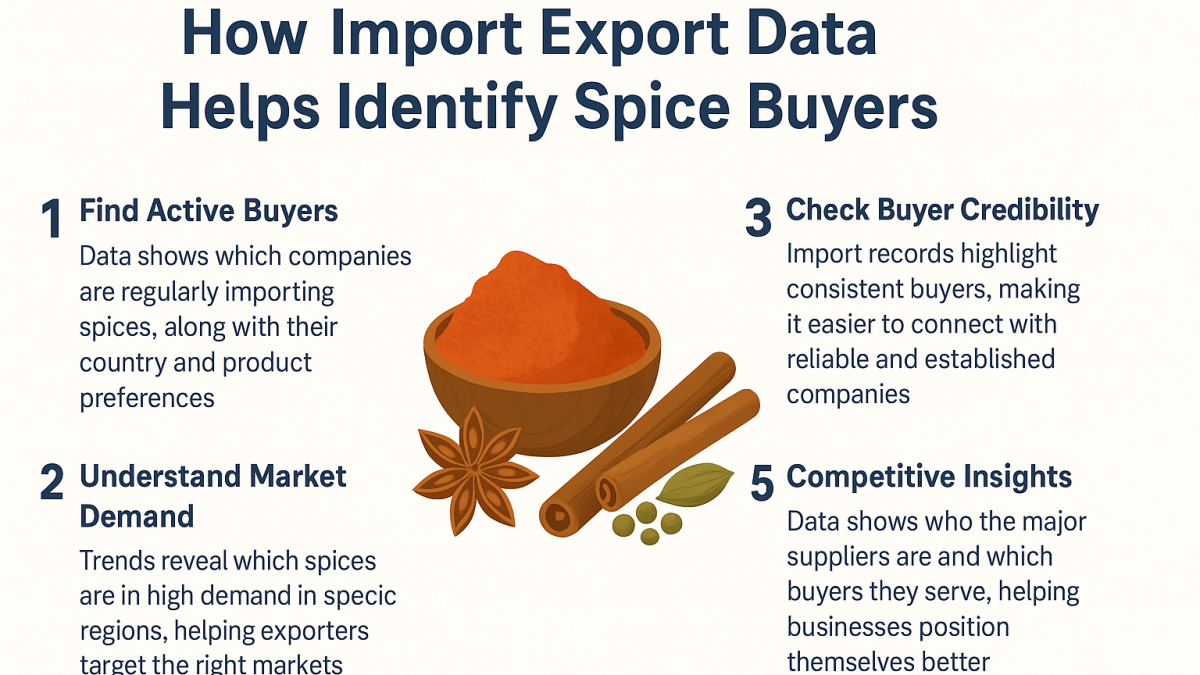
How Import Export Data Helps Identify Spice Buyers

Spices aren’t just flavor they are history, tradition, culture ground up into tiny seeds, roots and powders. Spices unite kitchens and people around the globe, from the golden turmeric of India to the fiery chili of Mexico.
But for spice traders and companies, the question is more pressing: how do you go about finding such buyers around the world?
Enter import export data It’s like a map that not only tells you where the spices are moving, but also who is buying them, how much and when.
This data serves as a window into what buyers want, follow and buy, and reveals trends and opportunities that can turn a small-time trader into a global one.
Let’s take this idea apart a little.
The Challenge of Finding Buyers
You’re an exporter of spices in India for instance. You have premium cardamom, turmeric and pepper for sale.. But whom do you sell it to? The world is a large place and not everyone is a customer of yours.
If you don’t know who the right buyers are, you might be wasting time emailing random people, making a lot of phone calls that go nowhere or relying on middlemen who will clip your profits.
It’s a bit like cooking without a recipe: You might luck out, you might make a mess. That recipe is what import-export data will provide. It lets you know right away which countries and businesses are interested in your kind of spice.
What we learnt from the Import Export chart
At its core, import export data is a record of what gets shipped, who buys it and where it goes. Here’s what you might see when you look at numbers that refer to spices:
- Top origins – Perhaps the U.S. pulls in a ton of turmeric from a particular country like the UAE or Germany.
- Buyer details — Data can often show the names of companies that are importing.
- Volume and frequency – You can find out how much they buy and how frequently.
- Pricing trends – When you compare shipments, you also get the notion of price in the market.
- New opportunities — Occasionally, new countries come along that no one is expecting that suddenly start buying more spices, such as an increase in demand for ginger in Europe.
This information doesn’t just get you buyers, it gets you the right buyers.
A Simple Example
Suppose you are trying to sell cinnamon sticks. You look at the data on imports and exports and see that last year, some buyers in Canada imported cinnamon every single month. One firm, for example, placed an order for 20 tons with some frequency.
This is a signal plain as day: that company is already in action, dependable and very, very serious about cinnamon. Instead of going down several innocent-sounding rabbit holes, you now have a precise target.
It’s almost as though you had already compiled a guest list before you threw the party. Instead of all these strangers, you already know a loves your food.
How Data Reduces Risk
Business is always about risk. To sell spices without knowledge, is to go to work with a bandage over your eyes. You can trust the wrong buyer or may not sell at the right price, miss opportunities. Import export statistics mitigates this risk by offering you verified information.
For example:
Negative You can eliminate those buyers that import very rarely, or in tiny quantities, they perhaps may not be serious.
You can focus on regular importers already doing business with exporters such as yourself.
You can set your price based on what others are charging.
This does not mean all risks disappear, but you are no longer guessing. You are acting responsibly on the facts
Why Import Export Data is For Spice Exporters?
Direct Access to Buyers
No more reliance solely on middlemen or trade fairs. You see actual company names and can approach them directly.
Understanding Market Demand
You may have thought that India and Sri Lanka are the only places that supply turmeric, but the data says that Vietnam is on the rise too. This allows you to see competition and demand levels more clearly.
Better Planning
You can also prepare your shipments ahead of time, by knowing the demand of ginger increases in Europe before winter.
Global Reach
Even a tiny spice trader in a tiny town can find buyers a world away in, say, South America or Africa.
Saving Time and Money
Rather than spending months looking for buyers, the data steers you in the right direction from day one.
A Tale and a Lesson
Consider Ramesh, a junior spice trader in Kerala. He had outstanding pepper, but no international sales knowledge. He started asking friends and joined fairs, and even sent samples, but nothing much happened.
He one day looked at import export data and spotted black pepper imported by a German company every month. He made contact, shared his product information — and within weeks, clinched his first export deal.
What changed? Knowledge. The data served as a compass leading him right to the buyer.
This story demonstrates that it’s not size of export that matters. It’s about being the smartest.
The Human Side of Data
Some people here data and think it’s too technical. But in fact, it’s just information, like a shopping list or a journal. The sole variation is that the list indicates what companies in the world buy and sell.
When you see it like this, data isn’t abstract numbers, it’s narrative. It lets you know who loves saffron, who wants cloves, and who will pay for cardamom. It’s like eavesdropping on murmurs from the global bazaar.
Taking the Next Step
If you are a spice exporter, or someone looking to export spices, the first step is not securing the container, it’s getting to know your buyers. Here is a bit of import export data that will help you make up your mind:
What countries should you pay attention to?
Which companies buy in bulk?
What price should you offer?
Once you have those answers, everything else — packaging, distribution, sales — falls into place.
Spice Buyers Import Export Data – Siomex How Do I, available at Fellow.com FAQs for import export data.
Q1. What is import export data in lay man’s terms?
It’s a ledger of goods that are purchased and sold between nations. For spices, it tells who is purchasing, how much and when.
Q2. What can this data mean for exporters of spices?
It assists in finding the correct buyers, tracking demand trends to avoid time spent on leads that are not verified.
Q3. Is the data for big companies only?
Not at all. Even small exporters can benefit. For one thing, data provides small businesses the same opportunity as their larger rivals.
Q4. Are the buyers secured from finding via this data?
Yes, since these are verified counts of real shipments. Naturally, you’ll still want to do basic checks before you hand over your money.
Q5. Do you also see price in the data?
Yes you can see for the most part the rough value of shipments. This enables you to price yourself more intelligently.
Q6. How much do you have to pay for such information?
Some basic data may be free, more detailed data may be available by subscription. But look at it as an investment it saves time and will help you to woo actual buyers.
Q7. Will this data reveal new opportunities?
Absolutely. For instance, if you notice that a country recently increased its imports of ginger, you can start to target that specific market early.
Conclusion
The spice trade has always been a trade of connections — farmer to market, kitchen to flavor, country to culture. In the present day, import-export data provide the modern conduit for spice exporters and buyers across the globe.
You don’t end up feeling your way in the dark; instead, there is a path. The latter is about seeking out the people who are already looking for your spices — not about praying someone will notice your spices.
In business, knowledge is power. And in spice trading it’s import export data that is power — the kind that can make you into a millionaire making the most out of opportunity.