
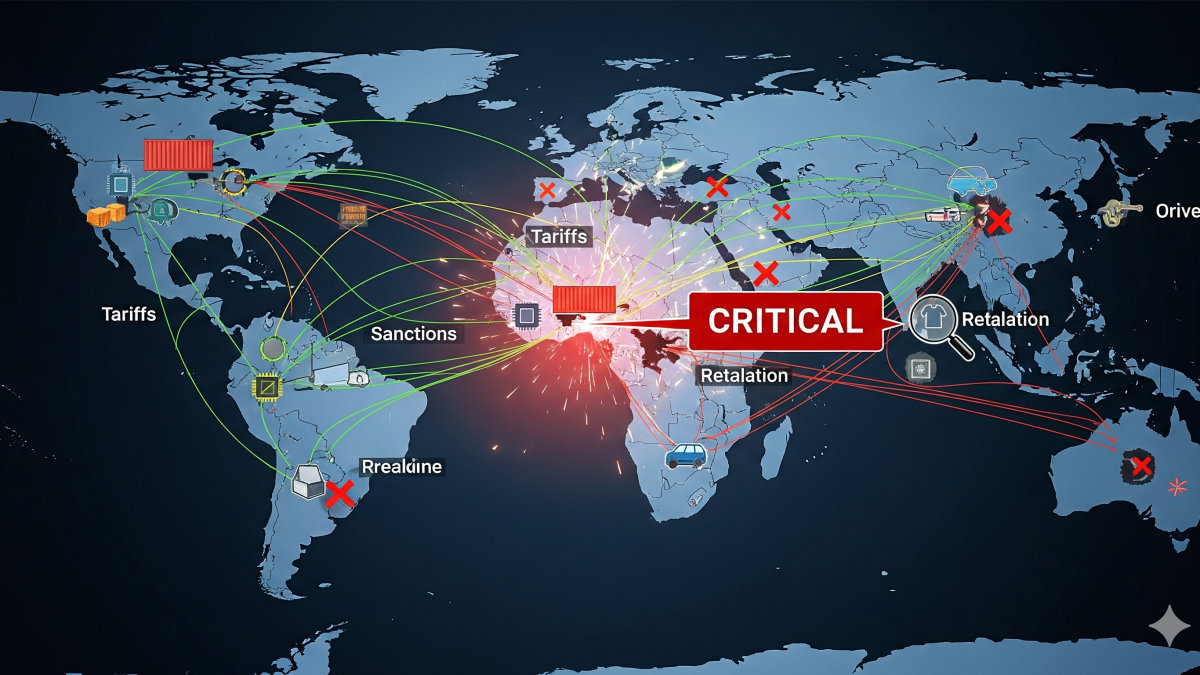
How the Trade War Affects Global Supply Chains

Today, no country is an island. Products, services, ideas flow across boundaries every second, every minute. The phone in your hand may be designed in California, manufactured in China and assembled with parts from Vietnam, South Korea, Japan, Taiwan and elsewhere.
This matrix of production is what we call a global supply chain.
Now picture a sudden wall slapped down in the middle of this baby-smooth system. That wall is a trade war. When nations levy new taxes on goods from one another or limit trade, the costs go beyond just two nations, but instead ripple down through the chain of businesses and consumers around the world.
Let’s dig deep into how trade wars rattle global supply chains, and do it in plain language, with real life-examples, and a style mix that makes it feel less like a textbook and more like the kind of chat you’d have over a cup of coffee.
What a Trade War Does, in Fewer Words
A trade war is what happens when two or more countries go into battle with each other not with bombs and tanks or riverboats or knights, but with money. Instead of swords, they wield tariffs (supplemental taxes on imports), quotas (limits on how much can be imported), or bans.
Think of it like this:
You and your neighbor typically trade fruit with one another. You go with apples, they come back with mangoes.
One day, one fateful day, you decide to tax every mango they give you.
In response they tax your apples.
Now suddenly both those fruits cost more, and you both struggle.
That’s precisely what happens between countries except the “fruits” are cars, steel, textiles, electronics and so on.
Why Supply Chains Are Hit the Hardest
Global supply chains are like a fragile spider web. You pull one thread and it shakes the whole thing. So this is how trade wars disrupt them:
Increased Costs
Companies find their parts suddenly cost more. For instance, when the U.S. imposed tariffs on Chinese steel, American car manufacturers had to pay more for the stuff. The added cost did not remain only in the factory; it was passed down to the consumer who ultimately purchased the car.
Delays in Production
Consider a phone company that gets batteries from Korea and screens from China. If a trade war renders screens more costly or scarce, the entire production lags. Customers wait longer.
Uncertainty for Businesses
Trade wars create fear. Companies can’t predict the future. Is it worthwhile for them to build new factories? Should they change suppliers? Many simply stop and wait, translating to slower growth.
Shift of Factories
Some companies are shifting production locations from one country to another to avoid tariffs. For instance, a number of firms moved production from China to Vietnam or India as the U.S.-China trade war escalated. But moving takes a lot it takes money, it takes time, it takes training.
Everyday Examples That Hit Home
Trade wars may seem designed to affect only giant companies, but the reality is that they affect the lives of ordinary consumers in small ways.
Smartphones: When tariffs raise the cost of parts, the phone you end up slipping into your pocket becomes pricier.
Groceries: Disputes over food products can force consumers to pay more for items from soybeans to meat to fruits.
Clothing: A lot of clothing is made from fabrics that travel the globe before they make it onto you. Tariffs along the way can also add to the price of even a basic T-shirt.
In the short term, what’s really going on is that what begins as a political maneuver ultimately reveals itself in your supermarket bill or your next online purchase.
The Fallout Around the World
When trade wars hit, they don’t just affect the countries targeted; they reverberate worldwide.
Small businesses in emerging economies: When two titans like the U.S. and China tussle, smaller countries suffer a loss in contracts or a drop in demand.
Consumers Around the World: Increases in one part of the food chain soon got passed along. For example, a tariff on steel in one country could drive up car costs in many nations.
Jobs on the Line: When companies pay more for their materials, they may save money in other ways and that can mean cutting jobs.
It’s a bit like tossing a stone into a pond the ripples continue far beyond where the stone landed.
Supply Chains Adaptation and Creativity in
Of course, humans are problem-solvers. Trade wars push companies to do something new:
Diversifying Suppliers
Businesses didn’t rely on one country for their supply chain, after all, but kept pieces of it in many. That reduces the chance of beiing caught by the tariffs.
Investing in Local Production
Some companies begin to make products here. For instance, a European company could construct a factory in Poland, rather than sourcing everything from Asia.
Using Technology
Digital tools allow companies to track the origins of goods and they offer some ability to identify how delays may impact goods and how that will play out for potential alternatives.
Negotiations and New Deals
The eclat of the country’s demise and the loss of a its rebel base camps give a plan; countries also try to make peace by way of new supply chain trade deals.
A Story-Like Angle
Imagine a global supply chain as a relay race. The baton (an item) is handed from one runner (nation) to the next. One creates the raw material, one assembles it, one packages it, one sells it.
Now, suppose one runner were to suddenly decide that they won’t hand over the baton to the next runner unless they’re paid extra to do so. The race slows down. Other runners stumble. The audience (consumers) gets frustrated. That’s the trade war effect.
Looking Ahead: Will Supply Chains Even Remain Global?
Here is a question that trade wars have suddenly made relevant to everyone: Should the world continue to rely so much on global supply chains?
Some experts say businesses will “regionalize” supply chains — keeping things closer to home, Asia for Asia, Europe for Europe. Others believe that foreign links are simply too deep to sever entirely, but countries will be more careful not to become too reliant on one party.
And what is clear is this: Supply chains will change, but they are not going away. These days, the world is too connected for that.
Conclusion
The trade wars are more than headlines, they are real-world roadblocks to the smooth movement of goods around the globe. They raise costs, slow production and sow uncertainty. From a Brazilian farmer to a smartphone user in India, the impact is universal.
At the same time it is forcing businesses to be smarter, more flexible and more creative in constructing supply chains that can withstand shocks.
So next time you see a price moving up or a delivery taking longer, remember: somewhere, a trade war may be to blame.
FAQs
Q1. What’s the easiest definition for trade war?
A trade war is a fighting between countries using taxes or limits on each other’s imports and exports, instead trading and working together.
Q2. What does a trade war mean for me as a consumer?
You could end up paying more for clothes, food, cars or electronics, as companies pass those price increases on to buyers.
Q3. Why do countries launch trade wars?
Typically, to save local industries, decrease imports or demonstrate economic power. But the effects frequently ricochet and harm others.
Q4. Can trade wars ever be good?
In some rare cases, they may even help local businesses to grow by blocking out foreign competition. But in the big picture, they do more harm than good.
Q5. How do companies manage trade wars?
They seek out new suppliers, relocate factories, invest in technology or channel efforts toward local production to avoid disruptions.
Q6. Are global supply chains set to unravel as a result of trade wars?
No, but they may change. Companies will attempt to dilute risk by relying on more countries than one.