
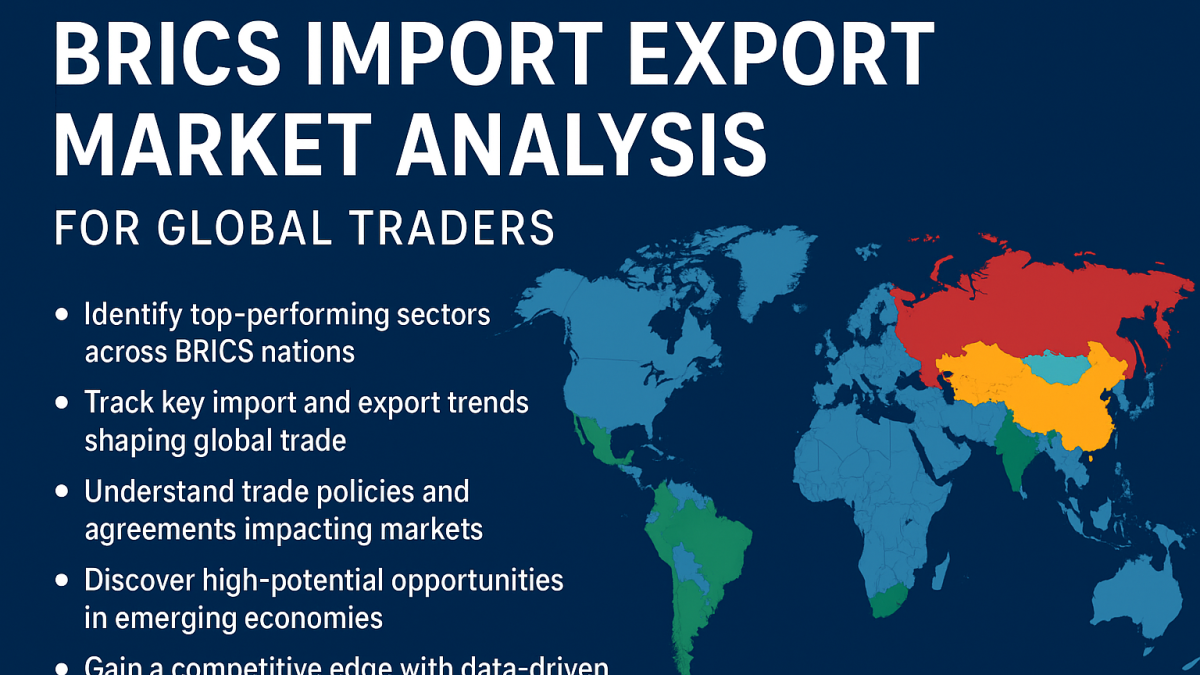
BRICS Import Export Market Analysis for International Traders

The world of trade is an enormous spider web — every country is a dot, and all are connected by products, services, and ideas. The BRICS group Brazil, Russia, India, China, and South Africa is a large knot of potential in this web.
Together, these five countries have vast resources, large populations, and diverse economies. For international merchants, mastering the art of playing the BRICS import-export game can mean the difference between simply being a player in the game and being a winner of the game.
Let’s look a bit closer at what gives BRICS such strength, how trade within and outside the group plays out, and where merchants can find opportunities.
Why BRICS Matters in Global Trade
When you aggregate all the populations of the BRICS countries, you’re talking about over 40% of the global population. That’s not a number — it’s a huge consumer base. On the supply side, they have raw materials, manufacturing capacity, and agricultural production.
For example:
Brazil exports coffee, soybeans, beef, and iron ore to the world.
Russia produces a lot of oil, gas, and minerals.
India exports textiles, medicine, and IT services.
China produces electronics, machinery, and countless others.
South Africa is renowned for gold, diamonds, and fruits.
The diversity of what they produce and use makes BRICS members more than merely trading partners — they are trading powerhouses.
Import and Export Flows in BRICS
Trade among BRICS is increasing, yet every country also has special export relationships with the rest of the world. This is how the trade flow is:
Brazil → China: Exports soybeans, iron ore, and beef, and in return imports electronics and machinery.
Russia → India & China: Energy products like oil and gas are the prominent, while it imports machinery, cars, and agricultural products.
India → South Africa & Russia: Export jewelry, machinery, and pharmaceuticals, and import oil and minerals.
China → All BRICS: Electronic products, textiles, and industrial equipment are the main exports.
South Africa → BRICS: Precious metals, minerals, and crops find a market in Brazil, India, and China.
It is simple to understand the trend here each country uses their own capabilities to meet the other’s needs.
Global Traders and the BRICS Opportunity
For non-BRICS traders, these five nations are gold mines waiting to be tapped with the proper strategy. Here’s why:
Huge demand: Expanding middle classes in India, China, and Brazil translate to more demand for imported products.
Multiple supply sources: If you require oil, wheat, coffee, or electronics, you have them within BRICS.
Political influence: BRICS members have been attempting to increase commerce using their local currencies, thus reducing US dollar reliance.
For example, a Dutch dairy products exporter might find a hot demand for his or her products in China’s urban areas. Or, an Algerian textiles company might send fabric to Brazil’s clothing designers.
Challenges in BRICS Trade
It ain’t all roses. Traders must watch out for:
Policy flips: Tariff or trade regulation fluctuations can affect profits instantly.
Currency fluctuations: Exchange rates can be the difference between winning or losing a sale.
Infrastructure limitations: China’s port facilities are world-class, but some Brazilian or South African areas may still involve some delays.
Political turmoil: Geopolitical events, such as sanctions, can shake up supply chains.
A savvy trader takes these as signals to prepare, not reasons to avoid the market.
BRICS Sectors to Watch
There are specific sectors that are booming in these five nations, and they are the ones that make them trade hubs:
- a) Energy
Russia, Brazil, and South Africa are sitting atop vast oil, gas, and coal reserves. BRICS as well as non-BRICS nations source their energy needs from them.
- b) Agriculture
Indian rice, Brazilian soybeans, and South African citrus fruits are in great demand worldwide.
- c) Technology & Manufacturing
China is leading in electronics and machinery, and India is catching up in software and internet services.
- d) Precious Metals
South African gold, Russian diamonds, and platinum have permanent buyers anywhere in the world.
- e) Pharmaceuticals
Indian low-cost, high-quality drugs are expanding at a fast rate.
How Global Traders Can Bridge the Gap
Going into BRICS nations is not a question of being a giant corporation. Small traders can do it too by focusing on:
Market intelligence: Understand what is in demand in each of the BRICS nations. For instance, packaged health foods are trendy in urban China, but renewable energy technology is trendy in Brazil.
Local alliances: Having a good local distributor can help with cultural and legal difficulties.
Flexible payment terms: Offering payment terms in various currencies might make your deals more attractive.
Utilizing trade statistics: Websites like Siomex offer access to import-export statistics, which enable traders to locate the desired suppliers and buyers with ease in short time.
The Future of BRICS Trade
The BRICS nations already ponder expanding the bloc and having a larger share in world trade negotiations. This could involve:
Increased trade agreements between the group members.
Growing pressure to employ domestic currencies.
More investment in infrastructure to expedite trade and lower costs.
To entrepreneurs, it translates into more opportunity, bigger markets, and perhaps more efficient channels of trade.
Real-World Example
You are a Middle Eastern merchant who sells dates and dried fruits. You research BRICS figures and find out:
India buys enormous quantities of dates during festival seasons.
China’s urban snacking culture loves packaged dried fruits.
Brazil’s health-oriented population is embracing such products.
By identifying these trends, you can create a seasonal export plan — shipping bulk orders before the large holidays or public health campaigns in these countries.
Traders’ Key Takeaways
BRICS is not a single market – approach each country separately.
Data is your friend – use trade data providers like Siomex to limit guesswork.
Be adaptable – economic, political, and currency swings will happen.
Look for niche markets – small but regular requests can become gigantic business.
Conclusion
The BRICS import-export market is a world within a world. To international buyers and sellers, it offers scale, diversity, and long-term growth potential. With knowledge of each member’s strengths, keeping up with trends, and using the right tools, you can capitalize on this robust network.
BRICS isn’t just a set of five letters it’s five gateways to the global economy. If you’re ready to explore, the opportunities are already waiting.
FAQs
Q1. What is BRICS in trade?
BRICS is a group of five major economies -Brazil, Russia, India, China, and South Africa — that work together in various areas, including trade.
Q2. Why is BRICS important for global traders?
It represents over 40% of global population and most production and consumption worldwide. That’s an enormous market for goods and services.
Q3. What are the most promising sectors in BRICS trade?
Agriculture, energy, manufacturing, technology, precious metals, and pharmaceuticals show strong growth.
Q4. How do I identify BRICS trade opportunities?
Use market research tools like Siomex, attend trade exhibitions, and establish local alliances.
Q5. What risks should traders be aware of?
Currency fluctuations, political tensions, infrastructure issues, and surprise policy shocks can affect trade.
Q6. Can small traders profit from BRICS markets?
Yes. As long as they have the right niche, product quality, and local contacts, even small traders can make it.