
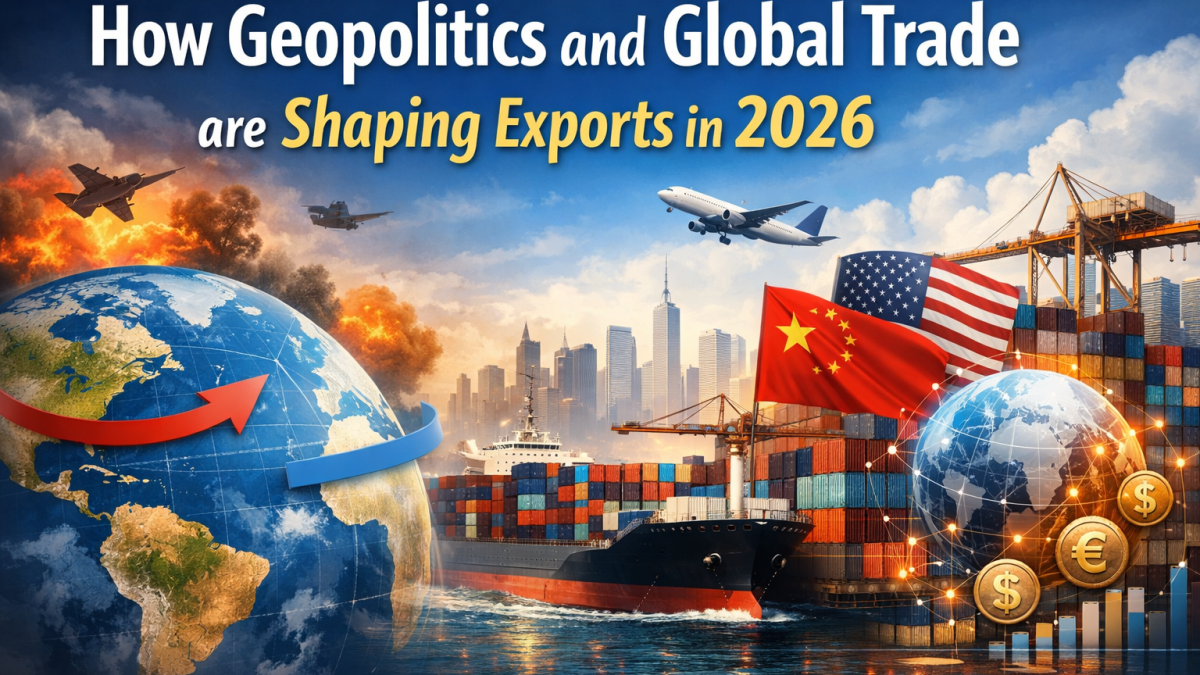
How Geopolitics and Global Trade are Shaping exports in 2026

Explore how geopolitics and global trade policies affect international markets in 2026 and how tariffs affect exports businesses.
Wars and geopolitical disruptions are the major reasons for the declining international trade market. Increasingly, geopolitics and global trade policies are playing a decisive role in determining how, where, and how much goods companies need to export. The war between middle east and Russia vs Ukraine are continuously creating political tension, and tariff wars.
A sudden increase in tariffs or the imposition of trade sanctions makes previously profitable markets inaccessible overnight and biggest financial loss. This uncertainty of the global market force exporters to re-evaluate their pricing, sourcing, and market strategies to balance their profit margin in foreign market.
By examining recent trade conflicts, we will explore how global politics and trade barriers influence export business and supply chains.
What are Geopolitics in Global Trade?
International relations and trade are highly dependent on political relationships, conflicts, and alliances of a country. When countries have political conflicts, they may stop trading and impose sanctions to limit their exports of businesses, which creates a disturbance in economic growth of the country. When Russia was at war with Ukraine, many Western countries placed sanctions on Russia by limiting their export business of oil, gas, and financial services.
Conflicts between nations can lead to higher tariffs and trade disputes that make goods more expensive for countries. The trade war between China and United States increased tariffs on electronics and steel, which affected the global trade market of electronics and infrastructure.
Instability between Iran and USA disrupt the global supply chain. By blocking Strait of Hormuz, Iran can easily affect the 20 – 25 % global fuel transportation. Because major oil exporters like Saudi Arabia, Iraq, UAE, Kuwait and Iran rely on Strait of Hormuz waterways.
In essence, geopolitics can shape a country’s economy by creating conflicts between nations and their allies.
How Tariffs Work in Global trade
Popularity of word “Tariffs” has increased due to its frequent use by Donald Trump. In simple terms, Tariff is a type of tax that is imposed by the government on imported goods and services from other countries.
Reasons why countries use Tariffs: –
Countries use tariffs for economic and political reasons. It is also a tool to regulate trade and protect national interests.
- Protect local industries
Government impose tariffs to Imported goods in their country to make foreign goods and services expansive. It encourages consumers to buy their own locally made products that help local businesses survive against foreign products.
- Support domestic job market
When citizens buy their own locally made products, it helps local businesses to expand factories locally and protects jobs within the country.
- Growth in government revenue
Tariffs are a source of income for government, and even developing countries still rely on tariffs for revenue. Since everyday countries import goods, tariffs provide a steady income to the government.
Real-World Examples of Geopolitics Affecting Exports
The real – world geopolitics conflicts that demonstrate how political tensions, policy decisions, and international conflicts can reshape export markets overnight.
US China Trade War
We have seen on global market that China and U.S. have the greatest rivalry, but they heavily rely on each other for import export trade. In 2018 U.S. president Donald trump accused China by putting 25% tariffs on $340 billion worth on Chinese goods. And in exchange of this unfair strategy China immediately responded U.S by putting tariffs on U.S. goods. In between this tit for tat tariffs battle, many companies started moving factories from China to Asian countries. This shift of market disrupted the demand and supply chain on the global market.
Russia Ukraine conflict
When Russia invaded Ukraine in February 2022, it ignites the major war between eastern Europe. In war response, many western countries, including the United States and members of the European union, imposed economic sanction against Russia.
Russia is one of the world’s largest exporters of oil and natural gas. When these sanctions were imposed, it restricted Russian energy exports that sharply affect fuel prices, electricity costs and transportation worldwide. This major conflict also disrupted global food shortage and led to rising food prices because Ukraine is a major exporter of wheat, corn and sunflower oil.
How Geopolitics and Tariffs Affect Exporters Directly
When a country imposes tariffs on imported goods, exporters from other countries increase the prices of goods in the foreign market to maintain their profit margins to cover the additional costs of their goods.
Geopolitical tension to market close
When relations between countries worsen, the government imposes sanctions on goods and services to create pressure for a country. In most extreme cases, this can even shut down entire industries that heavily depend on international trade.
Exporters face supply chain disruptions
Geopolitical conflict disturbs major supply routes, making them unsafe or restricted for exporting goods. As a result, exporters may face higher shipping costs and delay in delivering goods.
Currency and financial risks increase
Currency fluctuations due to geopolitical instability shirk profit from export business; exporters often sign contracts from months before payment. If exchanges rates change at that time, profit for export business can swing drastically.
How Exporters Can Protect Their Business from Political Risks
To protect their businesses from political instability, tariffs, and wars. Exporters should protect their businesses by diversifying their business strategy in international trade markets.
Many exports company don’t rely on a single market or country. Instead, they sell their goods in multiple countries to make balanced markets across regions. If political tension or tariffs arise in one region, sales can drop, but losses can be easily covered by sales of other countries.
Exporters can also protect their businesses with government-supported export insurance. In India, such insurance helps exporters survive even if buyers fail to pay due to war or political instability.
Write best and strong international contracts for export business because these contracts protect exporter’s business from legal dispute, payments, risks, and misunderstanding across borders. In export trade, goods are shipped before payments received, if situation become instable in importing country buyer can delay payment or maybe they can refuse to pay. In this situation, companies protect their financial crises.
Conclusion
Conflicts between nations and sudden changes in trade policies and tariffs can quickly disrupt established global markets; this can increase risk for exporter business, but these can be manageable for export businesses if they plan strategically with right trade insurance, diversifying goods markets, and building strong international contracts. Ultimately, understanding geopolitics and its impact on trade is essential for business owners to develop strategic planning for export business in 2026.
FAQ
- What is the impact of geopolitics on the global trade market?
When political tension rises, countries often impose sanctions and tariffs to regulate and stop the goods export in their country. Political relationships between countries determine who trades with whom, what is traded, and at what cost.
- How does geopolitical instability create challenges for exporters?
International trade heavily depends on stable political relations, which help export businesses to operate smoothly, but political conflicts, wars and trade sanctions can disrupt supply chains and increase transportation costs.
- Why do countries impose trade sanctions?
The country’s government uses sanctions as tools for economic punishment or diplomatic strategy for international relations. Sanctions are often imposed when a country violates human rights and international law or threatens global security.
- What is the difference between trade sanctions and tariffs?
Trade sanctions are restrictions to punish or create pressure on a country to change their behavior; this may be limited or completely to stop trade of export goods. Tariff is export tax that government imposes on exported goods in their country to protect domestic industries and generate revenue.